

Cornell seafaring scientists are working to strike a more sustainable balance for commercial marine fisheries facing rising demand. According to the Food and Agriculture Organization (FAO) of the United Nations, global production of capture fisheries reached 92.6 million tons in 2013.
“As the world population is growing, it’s going to put more demand on getting food from the sea. We need to protect fish populations from overfishing, but there is no reason why wild fisheries can’t be harvested sustainably,” said Charles Greene, professor of earth and atmospheric sciences.
For Greene, protecting marine fish stocks while sustaining fisheries is a function of better data. Since the 1970s, fisheries agencies have used ship-based acoustic surveys to monitor fish stocks, make predictions, and set fishing season and catch limits. Acoustic surveys are conducted by ships cruising back and forth, transmitting sound at different frequencies into the ocean. When these sound waves hit something—like a school of fish—they scatter back to a transducer, which converts them into visual patterns scientists interpret to estimate the type, size and number of animals in the area.
But acoustic surveys using manned vessels are too expensive and time consuming to do frequently, which constrains their usefulness and quality. To survey the entire west coast of the United States, it takes special low-noise ships two months at a cost of $25,000 per day—and still only gives scientists a rough idea of what’s happening in the ocean at any given time.
“It’s like leaving a camera shutter open for two minutes versus seconds. You get a really blurry picture of where these fish are,” Greene said.
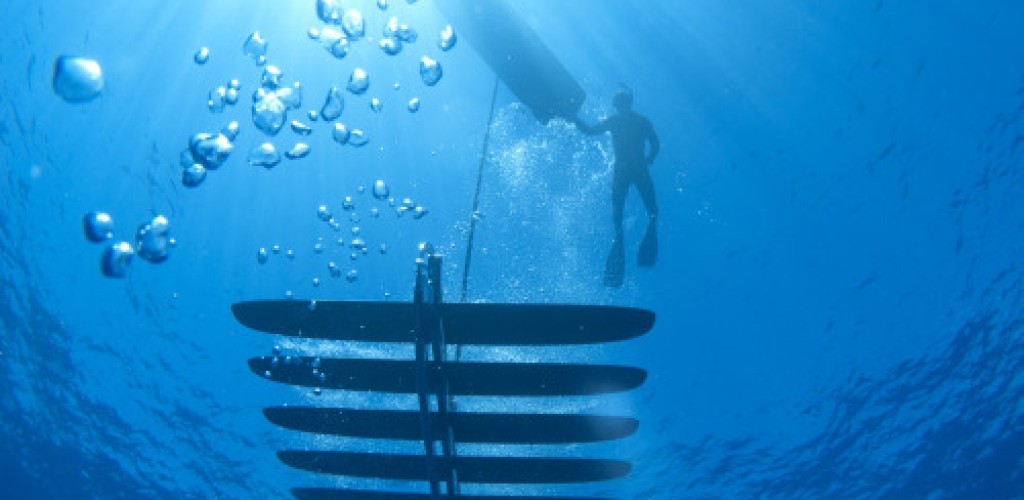
Since 2011, Greene has been collaborating with two companies—Liquid Robotics, Inc. (LRI) and BioSonics—to enable LRI’s autonomous Wave Glider robot to collect the same acoustic data as ships but at substantially lower maintenance and labor costs. The robot consists of a surface float housing electronics and solar panels, tethered by cable to an underwater glider with wings that generate propulsion and a rudder for steering. The glider tows an echo sounder, which transmits and receives the sound signals. It’s ideal for long deployments at sea, with a lightweight body, wireless data transmission and control, and efficient use of wave motion and solar energy for power. This spring, Greene is testing the latest version of the technologies his team developed, and he will be working with U.S. National Marine Fisheries Service scientists to evaluate the prospects of using Wave Gliders to create mobile ocean observing networks.
“With a fleet of Wave Gliders, it takes one week to survey the same area that would take a ship two months. And over those two months, we can get eight snapshots of fish distributions that are less blurry. With better data, we can reach for the holy grail of maximizing harvests from a fishery that is managed sustainably,” Greene said.
This article originally appeared in the Spring 2016 PeriodiCALS magazine


