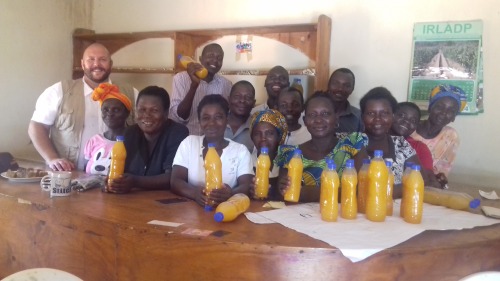
The Mpamba Fruit Juice Producers Cooperative in Nkhata Bay, Malawi, has a track record of innovation, in the form of juices made from local mangos, oranges, tangerines and pineapples. The small, mostly female collective of 22 farmers had established a reputation for their juices and successfully sold to tourist hotels along Lake Malawi, until problems with fleeting shelf life—one week with refrigeration—brought orders to a halt. Creative New Frontiers in Agriculture, a subsidiary of the U.S. Agency for International Development, urged Randy Worobo, professor of food science, to visit them, thinking his expertise in juice processing would be the right match for the co-op’s needs.
Arriving in Malawi last November, Worobo’s first thought was, “This ain’t Kansas.” And it wasn’t just the cavorting monkeys or blue flashes of cichlid fish jumping in Lake Malawi.
“Women in the co-op walked for up to six miles to bring their fresh fruit to the collective, where their process included peeling mangos by hand, using a hand-cranked juice extractor, and heating the juice over a wood fire,” Worobo recalled. “The brick processing building had smoke billowing out of the windows and doors.”
Production differences aside, the potential was obvious.
“Using their hand-cranked juicer, the juice was beautiful and flavorful,” Worobo said. “The mango diversity was amazing. There were many different varieties, from large domesticated purple ones to the smaller wild mangoes.”
The problem boiled down to, well, boiling. The group had been diligently following the incorrect guidelines they had been given previously: The more you heat the juice, the shorter the shelf life. Equipped with a new thermometer, Worobo advocated for the juice industry standard of holding the fresh juice at 85 degrees Celsius for three minutes, which is sufficient to kill any bacteria or fungal spores in the juice.
“You have to ignore some of the problems—the wood fire, unhygienic water and plastic buckets—and have faith in the processing method to deal with the defects and the deficits,” Worobo said. “And it did. It was phenomenal.”
By the time Worobo left three weeks later, the co-op’s juices had a commercially viable shelf life of six months to two years, and orders were coming in from hotels and grocery stores interested in carrying their brand. He left them with a few new tools he’d been able to acquire in country and a handwritten “juice bible” for the wall.
While there, Worobo also advised on business logistics, including label redesign and their first ever blind taste test of juice blends. The consensus was that mango-pineapple and mango-orange would be the best approach to product diversification that could increase their profits—and the wellbeing of the next generation.
“For many of the women, the co-op was clearly about securing the financial resources to send their daughters to school,” Worobo explained. “Although there are public schools, there are additional fees. If there’s not enough money to send all their children to school, the girls miss out.”