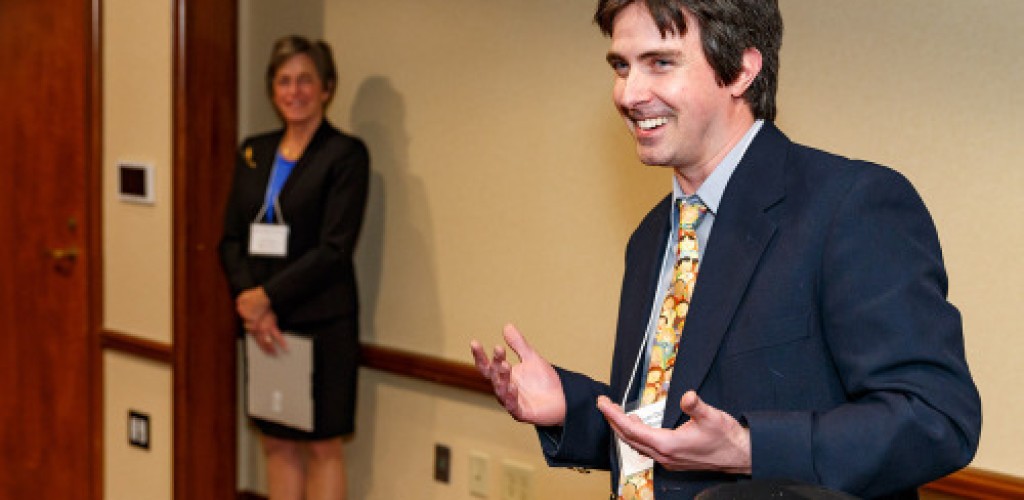
Bryan Duff, senior lecturer in the Horticulture Section, was one of two recipients of the 2016 Kaplan Family Faculty Fellowship in Service-Learning. He and Noliwe Rooks, associate professor of Africana studies, were recognized at the 15th annual award dinner, April 21.
Duff, who coordinates the undergraduate minor in education, redesigned the service-learning course, Engaging Students in Learning. The course engages community partners in the development and refinement of a service-learning course and gives Cornell students responsibility to plan and implement an after-school program for middle school students.
While the goal of the course had always been to help students improve their ability to engage learners and gain useful in-class skills, Duff felt it did not always provide the same level of interaction for every student. With support from the Engaged Faculty Fellowship Program, Duff shifted students from assisting in the classroom to running an after-school program at DeWitt Middle School.
Now Cornell students work directly with English as a second language learners through hands-on storytelling and filmmaking projects. The Kaplan fellowship will enable Duff to update video equipment and expand the program.