It’s the first day of class. Students take their seats, pull out their notebooks... and watch dozens of sea lions give birth, mere feet away.
Close encounters with sea lions, dolphins and penguins were regular occurrences for students in BIOEE 2525/2526, Ecology and Conservation of Wildlife in the Neotropics. This new year-long course was developed by Irby Lovette, Fuller Professor of Ornithology, and Leonardo Campagna, postdoctoral associate in the Fuller Evolutionary Biology Program at the Lab of Ornithology, with funding from an Internationalizing the Cornell Curriculum grant, sponsored by the Office of the Vice Provost for International Affairs.
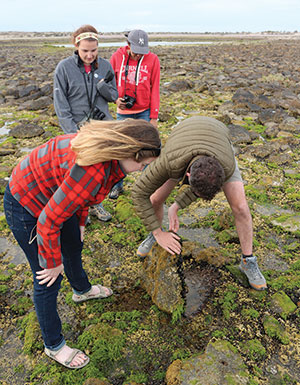
The course involves three components: During fall semester, students were trained in the scientific research process and statistics, and they discussed papers on the wildlife biology of Patagonia; over the winter break, the class traveled to coastal Argentina to study wildlife and develop projects individually and as a group; and now, in spring semester, the students are analyzing their data and gaining experience in scientific writing.
Jailene Hidalgo ’18, an environmental and sustainability sciences major, described the course as “life changing” for her.
“We got to see all kinds of animals and landscapes, but then we learned to observe them as scientists,” Hidalgo said. “We never forgot how awesome it was to be there, inches away from a penguin, two feet away from a sea lion or a dolphin.”
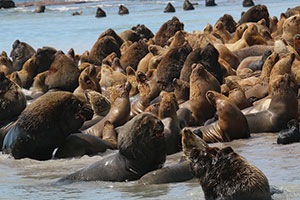
One of those experiences happened on their first day in Argentina, when students went to observe huge colonies of sea lions. The class arrived as the females were giving birth and “the beaches were covered with hundreds of just-born pups, none more than a few days old,” Lovette said.
Huge male sea lions were also charging around the beaches, because females go into estrus shortly after giving birth. The males engage in bloody battles to fend off rivals while keeping receptive females nearby. It was an opportunity for a “blitz project,” in which students would brainstorm research questions, develop a study strategy, and quickly collect loads of data on the fly. For example, on that first day in the field the class decided to study the amount of time males spent fighting, in relation to the number of females in their territory.
“We were able to spread students out so they were all watching different groups of animals,” Lovette said. “We spent maybe two hours on actual data collection and found a strong effect. Perhaps not surprisingly, the more females a male has, the more time he must spend defending his territory.”
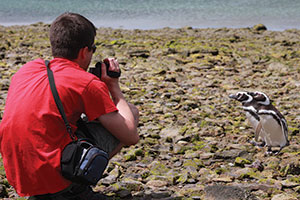
Lovette has been leading these kinds of field-based courses for more than 10 years. His other courses have taken students to Kenya and the Galapagos. But this is the first time he’s taught a course that covers an entire school year.
“I’ve never led a field class where we have this opportunity to prepare the students so well in advance, immerse ourselves in the field experience, and then process afterward,” he said. “This was liberating in that we could maximize our time in the field and take full advantage of those valuable weeks in an experiential setting.”
Hidalgo said the course has helped sharpen her research skills and ignite a passion for fieldwork.
“Because I got to learn about what I love by applying it practically, I feel more capable of taking on experiences like this again, on my path to becoming a wildlife biologist,” she said.