

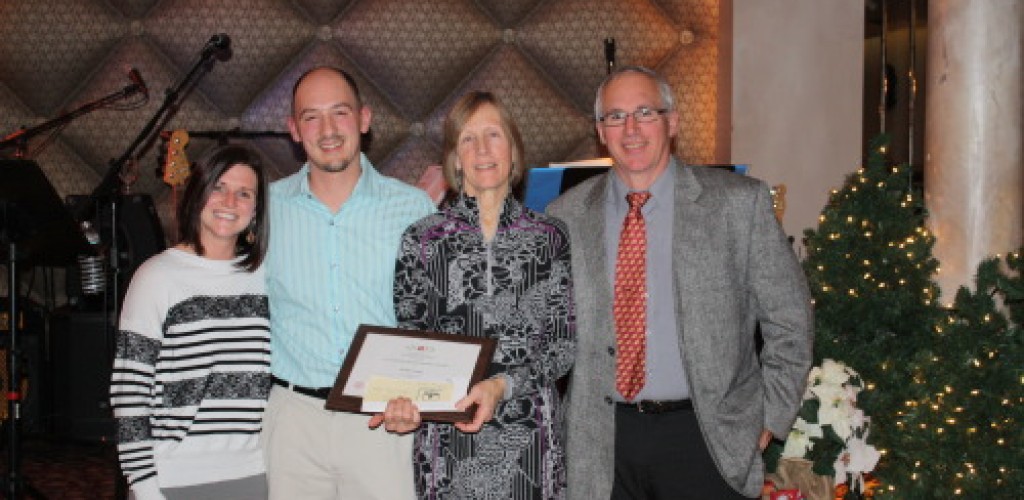
Holly Lange, a plant pathology technician in the School of Integrative Plant Science (SIPS), was named the 2015 NYSAES employee of the year at the annual station banquet Dec. 5. A 16-year veteran of the station, Lange was praised for her work ethic, excellence across a range of skills and eagerness to help students and faculty in any capacity needed.
For the past 12 years, Lange has worked as a technician in the lab of Professor Chris Smart. Lange oversees many of the daily tasks needed in a cutting-edge lab, including managing supplies, organization, lab experiments and field and greenhouse maintenance. Her responsibilities include the design, transplant production, planting, field maintenance, experimental procedures and data collection for field trials, along with DNA-based pathogen detection and genotyping in the lab.
“She works extremely hard to keep both my lab and field programs running smoothly. Much of the success of my lab is due to Holly,” said Smart. “I cannot imagine a better advocate for the work we do for the state of New York and beyond.”
Lange, described as “enthusiastic and energetic”, is someone who consistently exceeds expectations, according to Steve Reiners, chair of the Horticulture Section of SIPS. Reiners lauded her work as an ambassador to local schools, performing outreaching in local elementary schools and tutoring high school students.
“She is committed to the mission of the station and tries her best to move that mission forward,” Reiners said.
Lange earned her M.S. as part of the Cornell employee degree program. She helps diagnose vegetable disease for New York state growers while managing projects of her own. She also co-chairs the greenhouse committee and serves on the Field Research Unit committee, and volunteers with Station plantings.
Graduate and doctoral students at the experiment station applauded Lange for her work supporting students and project. Many credited her ability to stay focused on the organization of the lab and being a consistently friendly and upbeat member of the team.


