

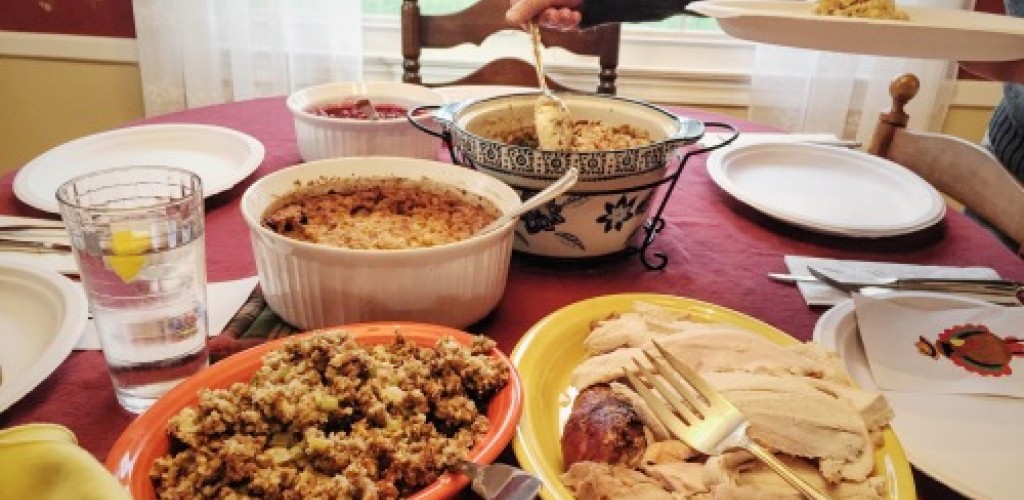
Think your Thanksgiving meal must be richer, fattier and far unhealthier than the food your grandparents ate in the trimmer days of yore? Turns out that doesn’t seem to be true. Analyses by the Cornell Food and Brand Lab in CALS’ Charles H. Dyson School of Applied Economics and Management investigated how holiday foods today compare to those in the 1950s, and they found little difference in calorie counts between the holiday meals.
Instead of asking dear old great-grandma how much she ate 60 years ago, the researchers did the next best thing: they compared recent cookbooks with cookbooks from that time.
With most everyday food, average calories per serving went up about 44 percent since the 1950s, according to Brian Wansink, professor and director of the Cornell Food and Brand Lab. “About two-thirds of that increase was because of more ingredients in the recipes — more butter, sugar, meat, and nuts — and the other one-third was because of increased portion size,” he said.
But that increase was for every day foods: What about Thanksgiving?
Interestingly, when analyzing Thanksgiving food favorites, the study found there was usually no difference in the calories. For instance, if you compare recipes from the 1956 edition of Joy of Cooking with the 2006 version, most of the foods from the recent cookbook have either the same calorie content or a slightly lower content than 50 years ago. Some even had dramatically lower counts: “Stuffing for instance has only 58 percent of the calories as it did in the 1950s,” Wansink said.
A big reason calories generally haven’t changed over the years is that they are often basic commodities that are prepared in simple ways. “An ear of corn isn’t getting more caloric over the years and nobody’s getting fancier in how they boil it,” Wansink explained.
Wansink said Thanksgiving is one of the greatest American holidays — partly because of what can mean for our country, for families, and for our personal outlook, and probably shouldn’t be the day to go on a diet. But if you want to eat less, he advised a simple rule of thumb: “Only eat foods that are homemade. You’ll eat about 11 percent fewer calories.”


