Educating a new audience about genomic selection is not so different from the process itself. It requires time, plenty of preparation and extensive knowledge.
And like genomic selection itself, the results may be revolutionary.
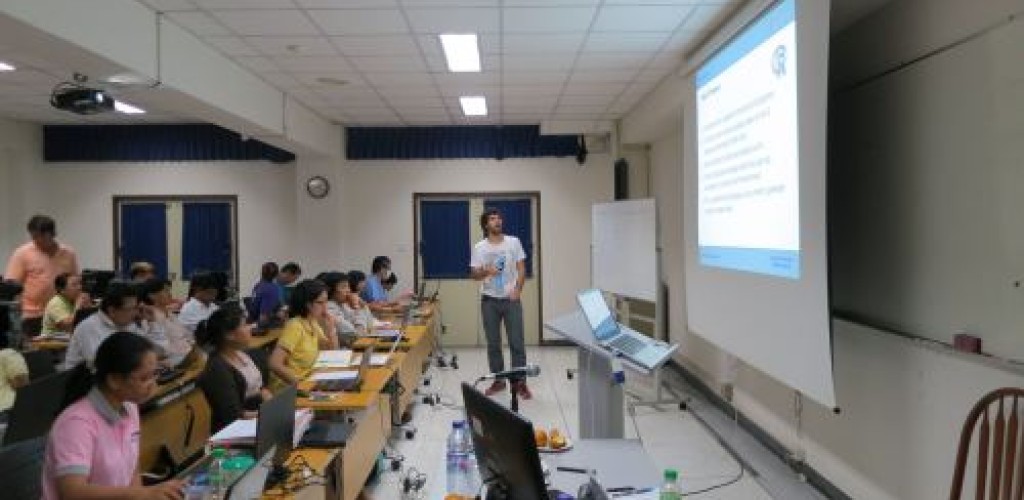
In April, Mark Sorrells, a professor of Plant Breeding and Genetics in the School of Integrative Plant Science, and postdoctoral associate Julio Isidro Sánchez traveled to Thailand to teach a one-week workshop on genomic selection at Kasetsart University’s Kamphaeng Saen campus.
Genomic selection is a unique tool in genetics that allows plant breeders to improve complex traits using genome-wide molecular markers. Whereas scientists could previously rely on a few markers in DNA for a breeding selection, now they can look at thousands of markers, resulting in higher accuracy of selection and a much faster process. A plant breeding selection that previously took 10 years to release can now be completed in six or seven years, according to Sánchez.
“Traditional selection relies on selection at the end of the growth cycle,” Sánchez said. “Genomic selection will allow you, without putting that plant in the ground, to predict the value of a particular trait just based on the genotype. You don´t have to wait until the end of the cycle to make selection.”
But learning the ins and outs of genomic selection – which can be applied to all crops as well as trees – is no simple task. The process requires a background in both genetics and statistics, which can make it a challenging concept for new students to grasp in a one-week workshop.
“You have to start from the beginning and build it up a little bit every day,” Sánchez said. “The first day was tough but after that people got along and had more confidence.”
Sorrells and Sánchez spent a month preparing for the workshop in which 41 people had enrolled; nearly double the matriculation of other workshops at the university. The audience was comprised of members of the university, seed companies and government agencies.
Each day began with a three-hour lecture during which Sorrells focused on a separate yet fundamental element of genomic selection. While Sorrells focused on theory and research, Sánchez led afternoon labs that helped participants to put the fresh concepts into practice. The workshop had a remarkably high completion rate of 95 percent at the end of the week, Sánchez said. The attendees also gave the course high marks in their evaluations.
“We were very pleased with the evaluation scores,” Sorrells said. “When you have that diverse of an audience, there are always a few people, sometimes quite a few, who don’t relate to the subject matter. But between the two of us we were able to bring along people who didn’t have as much of a genetics background.”
The researchers were invited to Kasetsart thanks to the close ties that university maintains with Cornell. Kasetsart’s Center of Agricultural Biotechnology is led by professor Pongthep Akratanakul, who received his Ph.D. in entomology at Cornell and last fall was hosted on the Ithaca campus by International Programs at the College of Agriculture and Life Sciences.
Additionally, Kasetsart horticulture professor Julapark Chunwongse received a Ph.D. in plant breeding and genetics at Cornell, and Ornubol Chomdej, a horticulture professor who helped Sorrells organize the course, came to Cornell as a visiting scientist. Cornell’s Plant Breeding and Genetics section currently has two Thai students working on their doctoral degrees as well.
Sorrells said that kind of overlap demonstrates the strength of Cornell’s international programs and is an enormous boon to global partnerships.
“Having that Cornell connection really helps to build collaborations across institutions and countries around the world,” said Sorrells, who specializes in plant breeding with a focus on small grain cereals.
Sorrells is optimistic the collaborations with Kasetsart will continue and he has already suggested future workshop topics, such as high-throughput phenotyping and statistical genomics. Cornell will also host a visiting scientist from Thailand for three months this year.
Sorrells and Sánchez were only in Thailand for a week but they took some time in their final days to travel down the coast to Chanthaburi Province, visiting markets, trying the local cuisine and soaking up the culture.
“People really were the highlight,” Sorrells said. “They were tremendous hosts. They made us feel right at home. And the participants in the workshop were really dedicated to learning the technology and they were easy to work with.”
During the week in Thailand, Sorrells was awarded a SUNY Chancellor’s Award for Excellence in Faculty Service. IP-CALS Director Ronnie Coffman tipped off CAB Director Akratanakul about the award, and Akratanakul organized a surprise reception for Sorrells, complete with pizza, chicken wings, beer, wine and black sticky rice.
“You can see why we liked these people” Sorrells said.
Other organizations that made the workshop possible were the National Science Technology and Innovation Policy Office by Thailand Advanced Institute of Science and Technology, the Center of Excellence on Agricultural Biotechnology, Office of Higher Education Commission, and the Ministry of Education.
David Nutt is a writer for the College of Agriculture and Life Sciences. Mark Sorrells wrote a first-person account of his trip while still on the road earlier this year, which you can fin here.