By John Carberry
What do you do when your portfolio of academics engaged in Indigenous Studies is among the best in North America, you have a first-of-its-kind residence hall that celebrates Native culture and is recognized around the globe, and you know a rising generation of students has increasing support from Native communities and matching increased expectations?
Bring them all together and begin building the future.
“I think we’re at a critical moment with the potential to build momentum through recruitment to raise the number of Native American students at Cornell,” said Associate Professor Jolene Rickard, director Cornell’s American Indian Program and citizen of the Tuscarora Nation. “We need a cohort, and we need to make clear the field of Native American and Indigenous Studies is here to stay – and growing.”
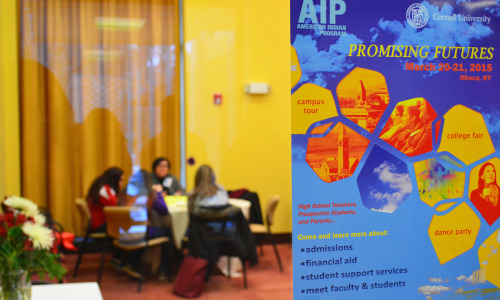
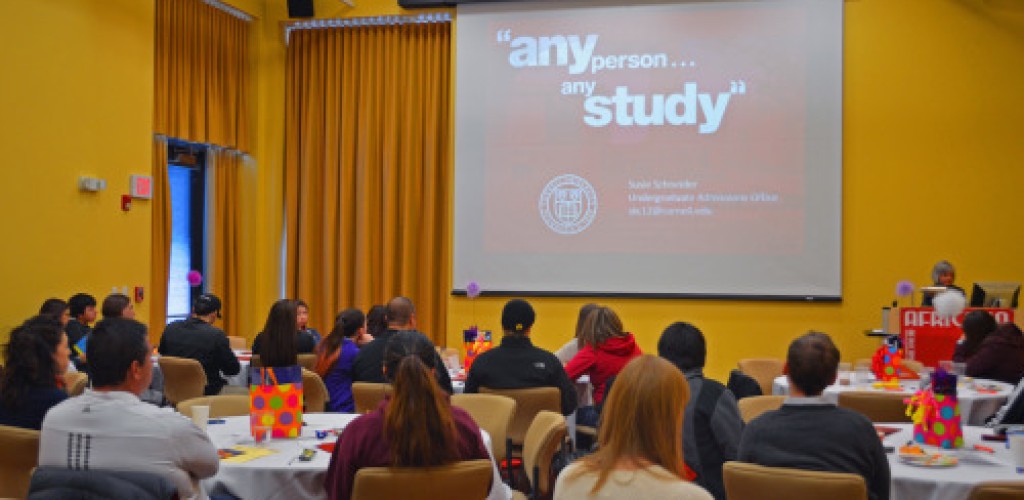
Delivering that message is the continuing mission of “Promising Futures,” a two-day student recruitment event run by AIP that’s now in its second year. With support from groups including the College of Agriculture and Life Sciences Admissions Office and the CALS Diversity Initiative, the late-March event brought to campus more than 30 prospective students from the region’s six Haudenosaunee nations and indigenous communities beyond. As it did in 2014, this year’s event at the Africana Studies and Research Center featured sessions on applying to Cornell, making the most of available financial aid, and an overview of the support services AIP can offer students.
New this year – and part of AIP’s increasing efforts to expose prospective students to the full range of research, including indigenous focused work going on across Cornell – was a Friday night “speed meeting” with faculty. In the 90-minute session, groups of five students met with any of 10 faculty and graduate researchers for 10-15 minutes each. By the end, all guests had a chance to hear from, and ask questions of, the academics working in the fields they might want to pursue.
“Up to the minute information on the latest research and market trends were shared with students underscoring the fact that learning is also, fun,” Rickard said. “The students wanted that Cornell experience, and we gave it to them.”
And it’s delivering that unique Cornell experience that Rickard said is the American Indian Program’s advantage when recruiting students from Native communities. While there are other higher education institutions that actively recruit students from the Haudenosaunee communities and other nations, Rickard said only Cornell can highlight two key features – Native students services that include the Akwe:kon residence and AIPs on-campus support base in Caldwell Hall, and indigenous peoples-focused academic programming that includes 17 full-time, supporting and visiting faculty members and the ability to craft majors and minors across the full breadth of one of the world’s leading research institutions.
“We have one of the top-flight programs to offer Native and any student interested in Native American and Indigenous Studies primarily because of the quality of the faculty’s research,” Rickard said. “And for the students, there’s a landing space for them during the day at Caldwell and when they’re ready to relax at Akwe:kon. That helps form community.”
“It’s this kind of enrichment that Cornell and AIP can offer,” she added, “that is key in developing young professional and future scholars.”
Currently, AIP serves more than 340 students (undergraduate, graduate and professional) and 79 registered Native students. The program also boasts one of the highest retention rates for Native students in the United States.
Rickard, whose faculty appointment is in the Department of History of Art and Visual Studies in the College of Arts and Sciences, said AIP is planning a third Promising Futures event for 2016 and hopes to expand its outreach and recruitment efforts nationally.
In addition to CALS, this year’s Promising Futures event was supported by the Akwe:kon Residential House, the American Indian Science and Engineering Society, the Cornell University Financial Aid Office, Cornell’s Undergraduate Admissions Office, the Indigenous Graduate Student Association, and Native American Students at Cornell. Six colleges sent ambassadors: The College of Arts and Sciences, the College of Architecture, Art and Planning, The College of Agriculture and Life Sciences, The College of Engineering, The School of Hotel Administration, and the School of Industrial and Labor Relations.