

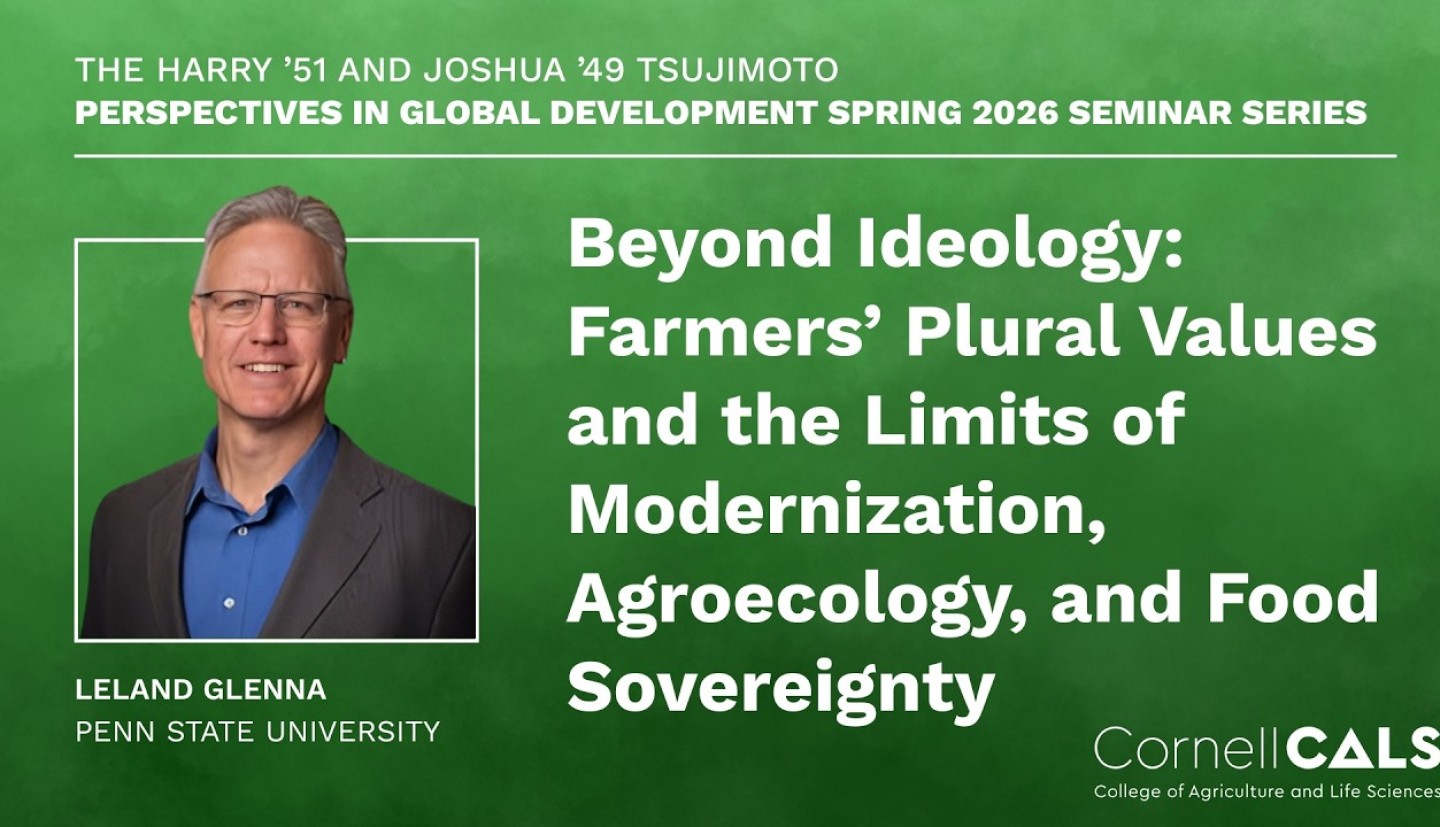
Spring 2026 Harry ’51 and Joshua ’49 Tsujimoto Perspectives in Global Development Seminar Series
About the speaker
Leland Glenna is a Professor of Rural Sociology and Science, Technology & Society at The Pennsylvania State University. He earned his Ph.D. from the University of Missouri in 1997. His research focuses on the social and environmental impacts of agricultural sciences and technologies and the ethical foundations for democratizing scientific research. Glenna has contributed to reports for the National Academies of Sciences, including one on genetically engineered crops, and has served as the president of the Agriculture, Food, and Human Values Society. He has received several awards for his teaching and research, including the Gamma Sigma Delta Excellence in Teaching Award in 2018, the Agriculture, Food & Human Values Society's Research Excellence Award in 2010, and the Rural Sociological Society Excellence in Research Award in 2024.
Abstract
The current mantra from many international development organizations and agricultural scientists is that agricultural production needs to double by 2050 to meet global food demand. Because of estimates that nearly 400 million people in the world are smallholder farmers and that these farmers manage over one-quarter of the world’s agricultural land and produce nearly three-quarters of food calories for vulnerable parts of the world, some claim that development efforts should focus on diffusing sophisticated technologies to these small farmers and on integrating them into commodity and input markets. However, one lesson from agricultural industrialization in the United States, collectivization in the Soviet Union, and the Green Revolution is that failing to consider the diverse needs of smallholder farmers when promoting agricultural research, technology diffusion, and market integration can lead to unintended negative consequences. This paper explores the policies and practices necessary to promote agricultural science and technology research directed at enhancing smallholder production and prosperity without undermining smallholder household livelihoods and harming vital ecosystems.
About the seminar series
The Harry ’51 & Joshua ’49 Tsujimoto Perspectives in Global Development Seminar Series showcases innovative approaches to development with experts from around the globe. Each year, the series attracts online registrants from over 45 countries and more than 350 organizations.
Seminars are held Wednesdays from 12:20-1:10 p.m. Eastern time during the semester in 175 Warren Hall. Students, faculty and the general public are welcome to attend in-person or via Zoom.
The series is co-sponsored by the Sections of Global Development and Natural Resources and the Environment and the Charles H. Dyson School of Applied Economics and Management as part of courses GDEV 4961, AEM 4961, NTRES 4961, GDEV 6960, AEM 6960, and NTRES 6960.
Date & Time
April 8, 2026
12:20 pm - 1:10 pm
Location
More information about this event.
Contact Information
Mariah Doyle-Stephenson
- md2237 [at] cornell.edu
Speaker
Departments
Global Development Section
Natural Resources and the Environment Section
Charles H. Dyson School of Applied Economics and Management
Ashley School of Global Development and the Environment
Related Events

Seminar
Lecture

We openly share valuable knowledge.
Sign up for more insights, discoveries and solutions.