

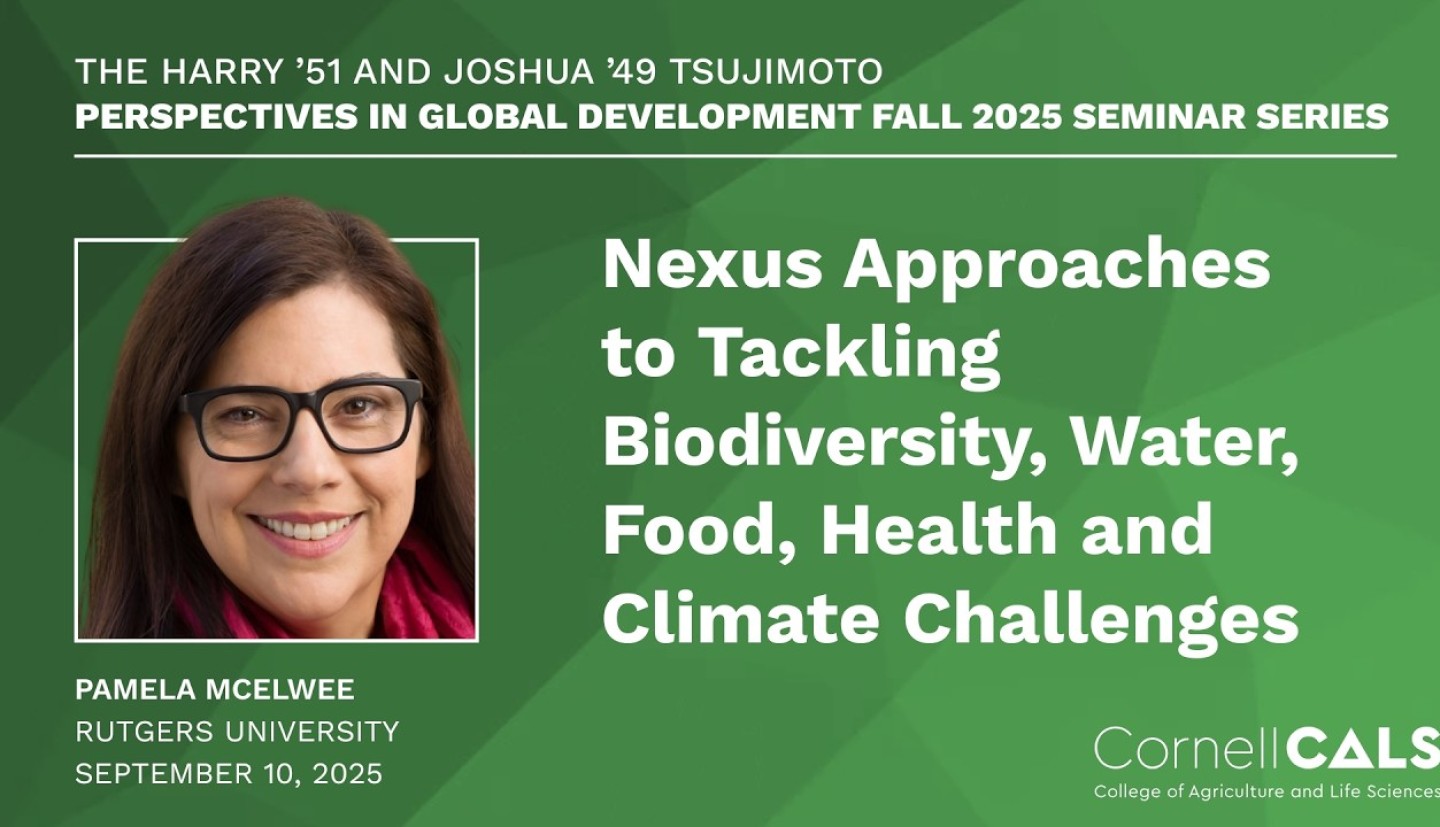
Fall 2025 Harry ’51 and Joshua ’49 Tsujimoto Perspectives in Global Development Seminar Series
About the speaker
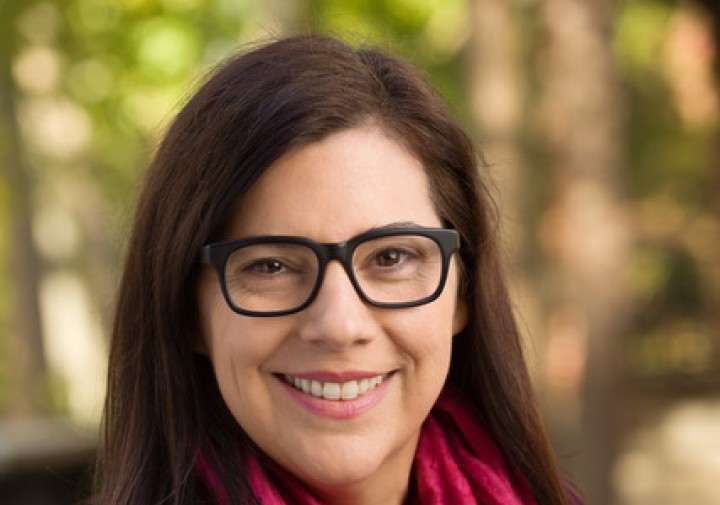
Pamela McElwee is Professor of Human Ecology at the School of Environmental and Biological Sciences at Rutgers University. Her research focuses on the intersections of biodiversity and climate, particularly human understanding of and adaptation to multiple drivers of environmental change, and has conducted fieldwork in Southeast Asia for several decades. She co-chaired the Intergovernmental Science-Policy Platform on Biodiversity and Ecosystem Services (IPBES) “nexus” assessment on biodiversity, water, food, health and climate change from 2021 to 2024. She also served as chapter lead for ecosystems, biodiversity, and ecosystem services for the Fifth US National Climate Assessment (2023), has been a lead author for the Intergovernmental Panel on Climate Change (IPCC) in AR6 and AR7, and founded and currently chairs the steering committee of the US Academic Alliance for the IPCC. She holds a joint Ph.D. in anthropology and forestry from Yale, and began her career as an environmental advisor to Senator Al Gore.
Abstract
Current global environmental crises like biodiversity loss, climate change, water scarcity, food insecurity, and poor health and wellbeing have most often been addressed individually, by separate processes and siloed approaches. Yet actions to address one crisis, such as climate change, have can often exacerbate the negative consequences of other crises, particularly with regards to biodiversity. A large body of scientific knowledge on each of these crises exists – but until recently there has not been a critical global synthesis on the interlinkages between these crises. The Intergovernmental Science-Policy Platform on Biodiversity and Ecosystem Services (IPBES) Nexus Assessment, adopted by member governments in December 2024, was designed to contribute a strengthened knowledge base for policymakers for informed, science-based decision-making. The report, involving 165 expert authors from 57 countries working together over a 3-year period, provides a comprehensive evaluation of the interconnected influences and dynamics among biodiversity, water, food, health, and climate change. The Assessment demonstrates that a wide range of response options are available now for tackling these crises together and provides the evidence and tools to support decision-makers in developing integrated decisions and actions.
About the seminar series
The Harry ’51 & Joshua ’49 Tsujimoto Perspectives in Global Development Seminar Series showcases innovative approaches to development with experts from around the globe. Each year, the series attracts online registrants from over 45 countries and more than 350 organizations.
Seminars are held Wednesdays from 12:20-1:10 p.m. Eastern time during the semester in 175 Warren Hall. Students, faculty and the general public are welcome to attend in-person or via Zoom.
The series is co-sponsored by the Department of Global Development, the Department of Natural Resources and the Environment, and the Charles H. Dyson School of Applied Economics and Management as part of courses GDEV 4961, AEM 4961, NTRES 4961, GDEV 6960, AEM 6960, and NTRES 6960.
Date & Time
September 10, 2025
12:20 pm - 1:10 pm
Location
More information about this event.
Contact Information
Mariah Doyle-Stephenson
- md2237 [at] cornell.edu
Speaker
Pamela McElwee, Rutgers University
Departments
Global Development Section
Natural Resources and the Environment Section
Charles H. Dyson School of Applied Economics and Management
Related Events

Seminar

Lecture

We openly share valuable knowledge.
Sign up for more insights, discoveries and solutions.