

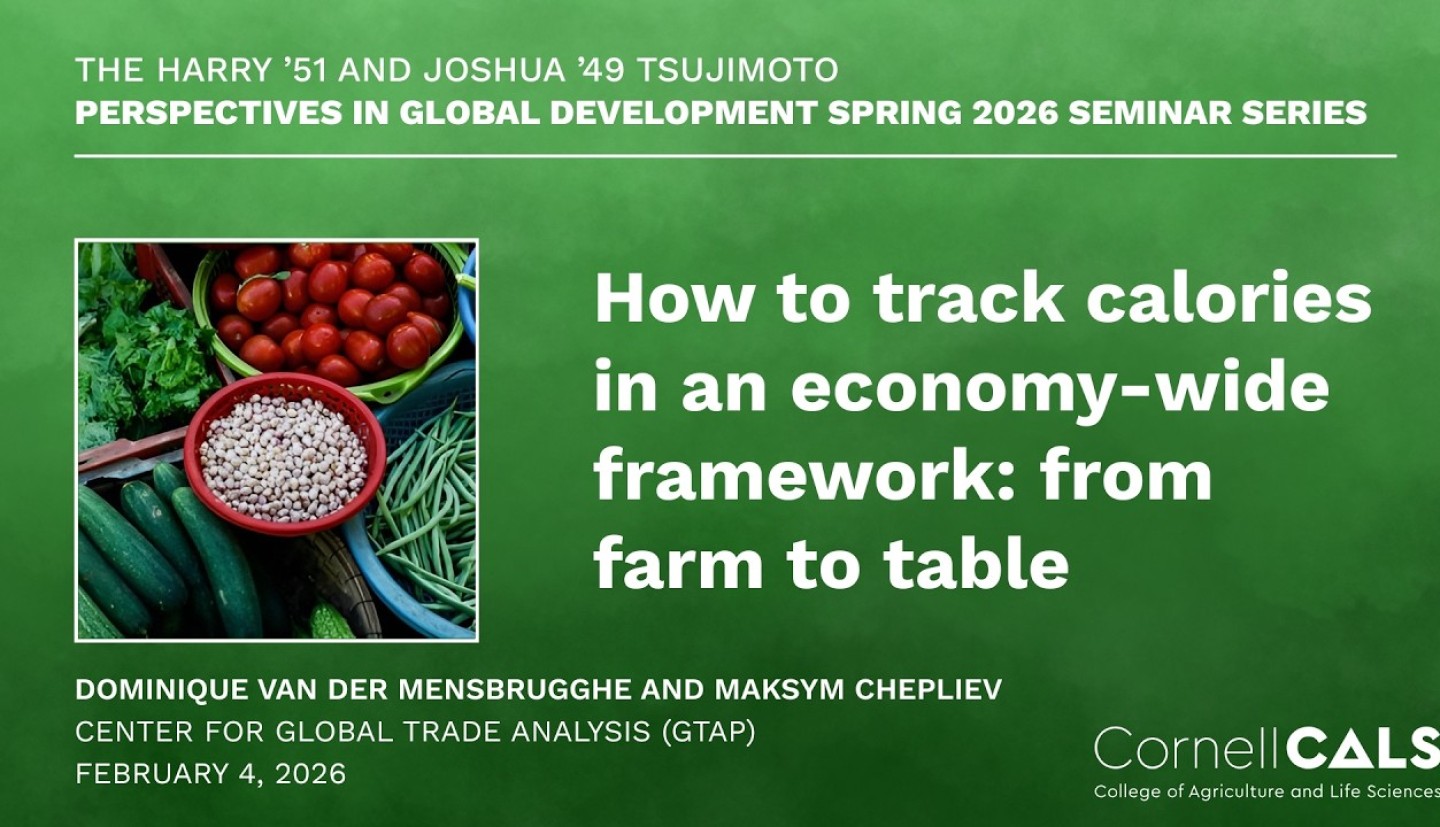
Spring 2026 Harry ’51 and Joshua ’49 Tsujimoto Perspectives in Global Development Seminar Series
About the speakers
Dr. Maksym Chepeliev is a Research Assistant Professor at the Center for Global Trade Analysis, Department of Agricultural Economics, Purdue University. Prior to joining Purdue, he was a Research Associate at the Institute for Economics and Forecasting at the National Academy of Sciences of Ukraine, where he received his PhD in 2016. His work focuses on the analysis of variety of global and regional economic issues, including dietary transition, climate change, circular economy, regional and multilateral trade agreements, and just energy transition. His research has been published in leading scientific journals, including Lancet, Proceedings of the National Academy of Sciences, Nature Food, Lancet Planetary Health, Joule, Renewable and Sustainable Energy Reviews, Energy Economics, Energy Policy and The Economic Journal. Maksym has also been a lead contributor to multiple flagship reports by international organizations including the World Bank, the International Monetary Fund, the United Nations Conference on Trade and Development, the European Bank for Reconstruction and Development, the Organisation for Economic Co-operation and Development, Heinrich Boell Foundation, and International Finance Corporation. He is regularly advising governments around the world on the implementation of specific policies and measures, including his recent contributions to the policy debates in Ukraine, Serbia, Türkiye, Tajikistan, Lithuania, Romania, Nigeria, the United States and Azerbaijan. He has been taking part in drafting strategic documents and legislations, such as Low Emission Development Strategies, Nationally Determined Contributions and National Renewable Action Plans in selected countries.
Dr. Dominique van der Mensbrugghe is Research Professor at the Center for Global Trade Analysis (GTAP) at Purdue University. His research focuses in analyzing economic policies of a global nature such as multilateral trade agreements and climate change and is an expert on global computable general equilibrium (CGE) modeling. His policy work has included analyzing agricultural support policies in the OECD countries, the Uruguay Round agreement and the proposed Doha Agenda, international migration, the Trump-administration initiated trade wars, carbon mitigation policies, and the economic impacts of climate change. He is the developer of the MANAGE single-country CGE model, the ENVISAGE global CGE model, the standard GTAP Model in GAMS global CGE model and is currently working on a version of the latter that incorporates sub-regional economies such as the U.S. states. Prior to joining Purdue University in 2014, he worked at the Organisation for Economic Co-Operation and Development (1988-1998), the World Bank (1998-2011), and the Food and Agriculture Organization of the United Nations (2011-2014). He has an undergraduate degree in mathematics from the Université Catholique de Louvain in Belgium and a PhD in economics from the University of California at Berkeley.
Abstract
Despite historical doubts about the ability to feed a growing population, between 1961 and 2015, population increased from 3 to 7.3 billion, some 137%, yet land devoted to crops increased by less than 35%, and the supply of per capita calories has increased. That does not imply that all is rosy. Many countries are faced with the dual dilemma of persistent hunger and rising overweightness and obesity. Additionally, high agricultural productivity has had negative environmental spillovers such as greenhouse gas emissions, ground and water pollution, stresses on bio-diversity and others. The world’s population is slated to grow by another 2-3 billion persons and planetary boundaries are being exceeded in many dimensions. Thus, looking ahead a few decades is needed to take preventive measures that will continue to improve the well-being of individuals while respecting sustainable agricultural practices.
This talk will discuss the requirements and challenges to quantitatively assessing future global demand and supply of food. Our starting point is economywide analysis. Building on numerous datasets we build a comprehensive view of the food supply chain from the farm, to agro-food processing, to household consumption. However, there are challenges in doing so as trade, shifting consumption patterns, inter-sectoral spillovers, food loss and waste and other factors make comprehensive analysis of the food supply chain a challenge. We will discuss the underlying assumptions required to project supply and demand: productivity and land availability on the supply side, population and income growth, and consumer preferences on the demand side, and how national imbalances are mediated by trade, merging the gap between agro-food systems and economy-wide analysis. The talk will highlight some of the complementary issues such as food loss and waste as well as environmental spillovers in the context of transitioning to healthier and more sustainable diets.
About the seminar series
The Harry ’51 & Joshua ’49 Tsujimoto Perspectives in Global Development Seminar Series showcases innovative approaches to development with experts from around the globe. Each year, the series attracts online registrants from over 45 countries and more than 350 organizations.
Seminars are held Wednesdays from 12:20-1:10 p.m. Eastern time during the semester in 175 Warren Hall. Students, faculty and the general public are welcome to attend in-person or via Zoom.
The series is co-sponsored by the Sections of Global Development and Natural Resources and the Environment and the Charles H. Dyson School of Applied Economics and Management as part of courses GDEV 4961, AEM 4961, NTRES 4961, GDEV 6960, AEM 6960, and NTRES 6960.
Date & Time
February 4, 2026
12:20 pm - 1:10 pm
Location
More information about this event.
Contact Information
Mariah Doyle-Stephenson
- md2237 [at] cornell.edu
Departments
Global Development Section
Natural Resources and the Environment Section
Charles H. Dyson School of Applied Economics and Management
Ashley School of Global Development and the Environment
Related Events

Seminar

Lecture

We openly share valuable knowledge.
Sign up for more insights, discoveries and solutions.