

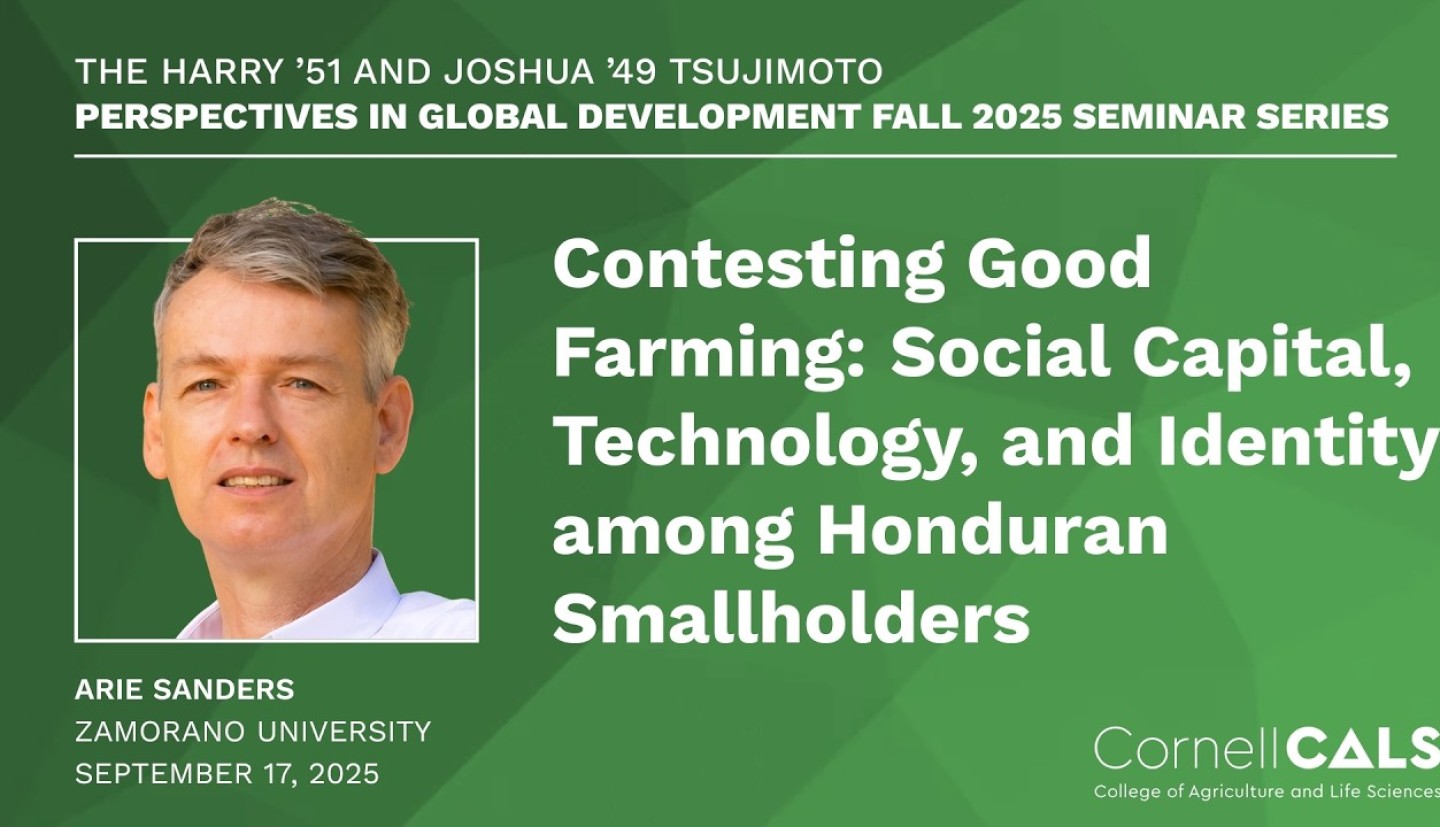
Fall 2025 Harry ’51 and Joshua ’49 Tsujimoto Perspectives in Global Development Seminar Series
About the speaker
Arie Sanders holds a PhD in Rural Sociology from Penn State University and a Master’s and BSc in Development Economics from Wageningen University & Research. He is the Associate Dean of the Graduate Program and Associate Professor in Agribusiness at Zamorano University, Honduras. With more than 30 years of experience in international development, Dr. Sanders has led initiatives on small-scale agriculture, value chain development, and gender inclusion across Central America. He has collaborated with the Feed the Future Innovation Lab on research in horticulture, gender, and sustainable production systems, and is currently working with the Smithsonian Institution on the governance of coastal resources in Central America.
Abstract
My talk examines pesticide use among smallholder potato farmers in Intibucá, Honduras, and how these practices are shaped by social as well as agronomic factors. Potatoes are a key livelihood crop in the highlands, but pest pressures, monocropping, and volatile markets have pushed farmers toward increasingly intensive pesticide regimes. While these applications help protect yields, they also bring significant costs—rising resistance, contamination of soil and water, and health risks for farming families.
I argue that pesticide use cannot be understood only as a technical matter. It is also a social act, tied to local norms of what it means to be a “good farmer.” In Intibucá, tidy, disease-free fields are visible symbols of skill and responsibility, reinforcing reputation and access to resources. This symbolic capital makes heavy spraying appear not just logical, but necessary. Drawing on Bourdieu’s concepts of habitus, field, and capital, I show how recognition, peer validation, and memory of past crop failures sustain these routines.
The talk also explores the potential of alternatives such as the Decision-Support-System Disk, a tool that can reduce fungicide use by up to 30% without yield loss. Yet, adoption is constrained because experimenting carries social risks: visible mistakes can damage reputation. Generational and gendered dynamics matter too—young farmers are more open to change, and women often manage the hidden health risks of pesticide use, though their knowledge is undervalued.
I conclude that promoting sustainable pest management requires more than introducing new technologies. Progress depends on engaging with the social dynamics of rural life—farmer-led trials, peer-to-peer learning, and incentives that reward careful rather than intensive management. Redefining what it means to be a good farmer is central to building healthier, more resilient production systems in Honduras.
About the seminar series
The Harry ’51 & Joshua ’49 Tsujimoto Perspectives in Global Development Seminar Series showcases innovative approaches to development with experts from around the globe. Each year, the series attracts online registrants from over 45 countries and more than 350 organizations.
Seminars are held Wednesdays from 12:20-1:10 p.m. eastern time during the semester in 175 Warren Hall. Students, faculty and the general public are welcome to attend in-person or via Zoom.
The series is co-sponsored by the Department of Global Development, the Department of Natural Resources and the Environment, and the Charles H. Dyson School of Applied Economics and Management as part of courses GDEV 4961, AEM 4961, NTRES 4961, GDEV 6960, AEM 6960, and NTRES 6960.
Date & Time
September 17, 2025
12:20 pm - 1:10 pm
Location
More information about this event.
Contact Information
Mariah Doyle-Stephenson
- md2237 [at] cornell.edu
Speaker
Arie Sanders, Zamorano University
Departments
Global Development Section
Natural Resources and the Environment Section
Charles H. Dyson School of Applied Economics and Management
Related Events
Seminar
Lecture

We openly share valuable knowledge.
Sign up for more insights, discoveries and solutions.