

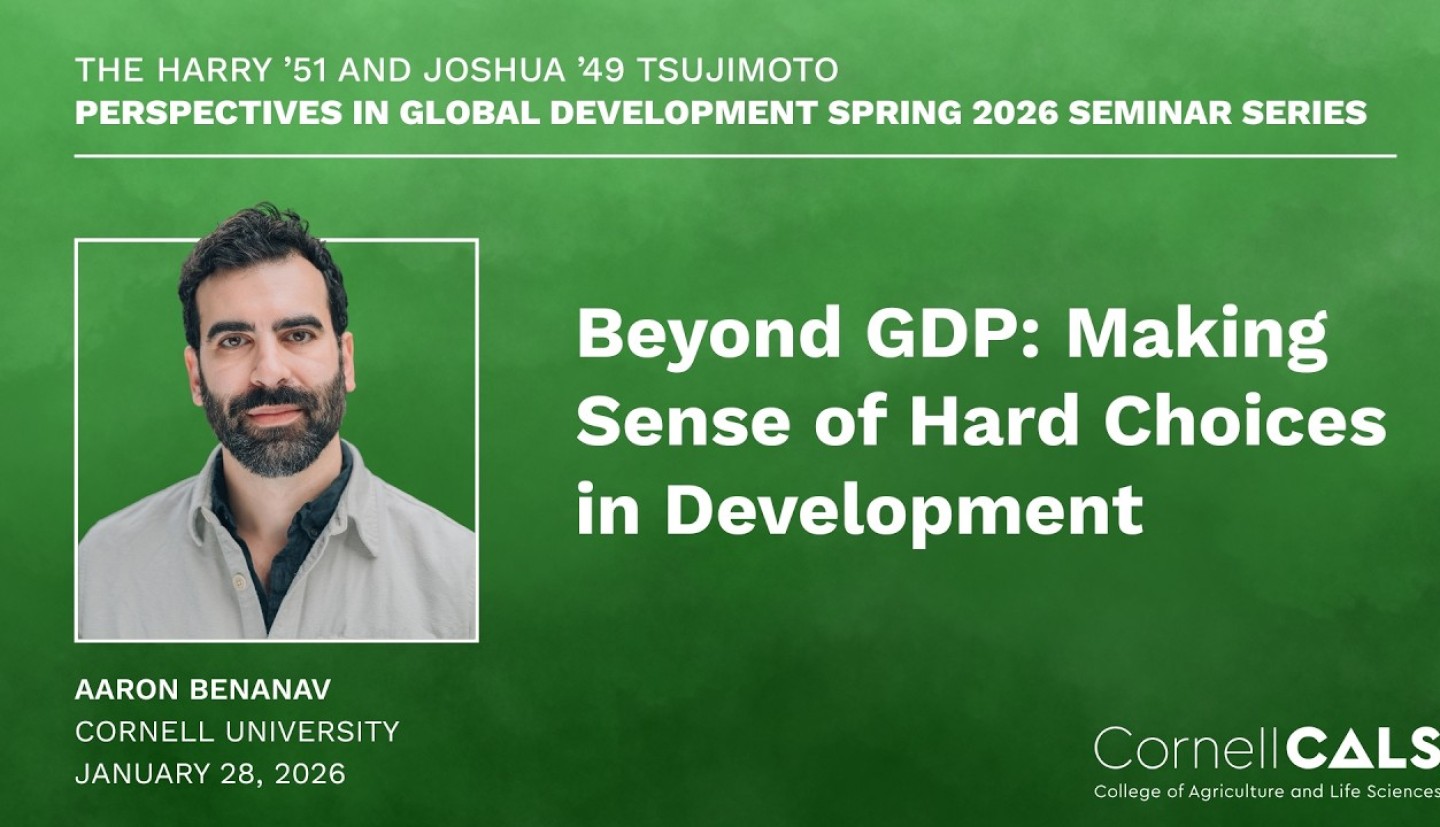
Spring 2026 Harry ’51 and Joshua ’49 Tsujimoto Perspectives in Global Development Seminar Series
About the speaker
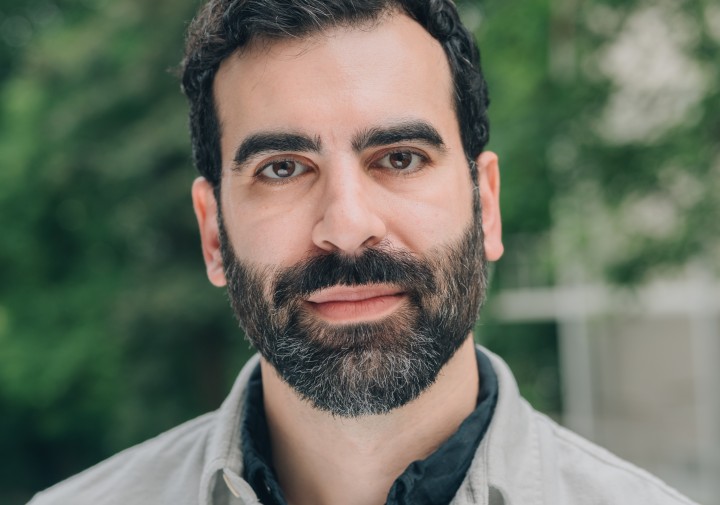
Aaron Benanav is an Assistant Professor in the Department of Global Development at Cornell University. He is an interdisciplinary researcher working at the intersection of history, sociology, and economic and social theory, whose research focuses on global unemployment, underemployment, and informality; automation and the future of work; global histories of social and economic development; the history of economic and social statistics; and alternative institutional arrangements for organizing economic life.
Benanav is the author of Automation and the Future of Work (Verso, 2020), which challenges technologically deterministic accounts of labor-market change, emphasizing instead the structural and institutional conditions that shape employment outcomes. It has been translated into twelve languages, with the most recent Portuguese edition including a new preface on artificial intelligence and the future of work. In 2025, Benanav published two long-form essays in New Left Review titled “Beyond Capitalism,” which examine the limits of growth- and efficiency-centered approaches to development and explore alternative ways of organizing investment and production. This work forms the basis of an ongoing book project on multi-dimensional approaches to economic development and how societies collectively choose among competing futures.
In addition to academic publications, Benanav is a frequent public commentator on issues related to work, technology, and economic development, appearing regularly in international media, podcasts, and public forums. At Cornell, he teaches undergraduate courses on ethics, technology, and development and graduate courses in social and development theory, and co-organizes the Seminar in Critical Development Studies.
Abstract
Over the past two decades, development thinking has moved decisively beyond GDP. From the OECD’s “Beyond GDP” dashboards to the United Nations Sustainable Development Goals, there is now broad agreement that progress must be understood as unfolding across multiple dimensions at once—health, sustainability, security, education, dignity, and meaningful work among them. Influenced by the capabilities approach associated with Amartya Sen and Martha Nussbaum, this shift has helped reorient development toward human flourishing. At the same time, this expansion of values has exposed a difficulty. While development frameworks now acknowledge many goals, they offer limited guidance for how to act when those goals collide under real resource constraints. This talk argues that we need a clearer account of the rationality of difficult development choices. When societies pursue multiple, non-substitutable goals, choosing a development pathway rarely has a single best answer. Instead, such decisions involve selecting among alternative trajectories that are each defensible but meaningfully different in what they prioritize. I develop a framework for treating these situations as cases of genuine choice—where economic reasoning clarifies constraints and possibilities, but judgment remains essential. Rather than viewing this indeterminacy as a failure, the talk frames it as an opportunity: a moment in which societies articulate who they are and what matters most to them. Because development unfolds over time, these choices need not be final; priorities and directions can be revisited as circumstances and collective judgments evolve.
About the seminar series
The Harry ’51 & Joshua ’49 Tsujimoto Perspectives in Global Development Seminar Series showcases innovative approaches to development with experts from around the globe. Each year, the series attracts online registrants from over 45 countries and more than 350 organizations.
Seminars are held Wednesdays from 12:20-1:10 p.m. Eastern time during the semester in 175 Warren Hall. Students, faculty and the general public are welcome to attend in-person or via Zoom.
The series is co-sponsored by the Sections of Global Development and Natural Resources and the Environment and the Charles H. Dyson School of Applied Economics and Management as part of courses GDEV 4961, AEM 4961, NTRES 4961, GDEV 6960, AEM 6960, and NTRES 6960.
Date & Time
January 28, 2026
12:20 pm - 1:10 pm
Location
More information about this event.
Contact Information
Mariah Doyle-Stephenson
- md2237 [at] cornell.edu
Speaker
Aaron Benanav
Departments
Global Development Section
Natural Resources and the Environment Section
Charles H. Dyson School of Applied Economics and Management
Ashley School of Global Development and the Environment
Related Events

Seminar

Lecture

We openly share valuable knowledge.
Sign up for more insights, discoveries and solutions.