

Department of Computational Biology
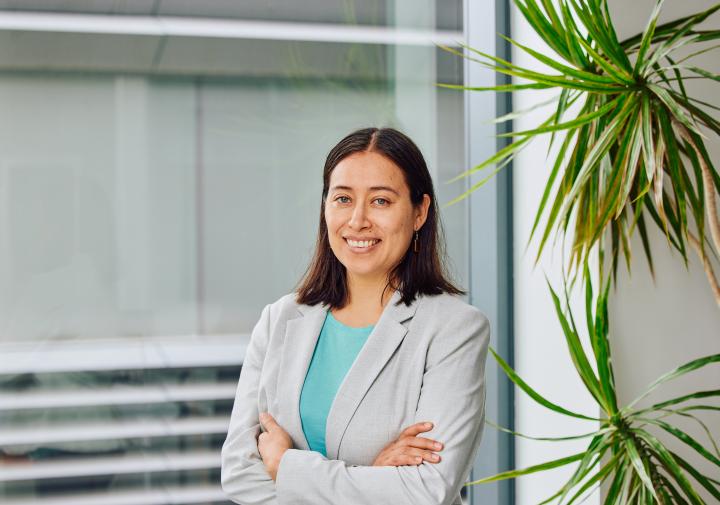
Featuring Dr. Emilia Huerta-Sanchez, Associate Professor, Department of Ecology and Evolutionary Biology, Brown University
The study of archaic introgression has already illuminated candidate genomic regions that affect the health and overall fitness of global populations. In this talk, I will focus on identifying regions where archaic ancestry could have been a useful source of standing genetic variation as modern human populations adapted to new environments. We pinpoint a gene MUC19, for which modern humans carry an archaic haplotype, which harbors a high density of Denisovan-specific variants, including nine of which are missense variants. We find the Denisovan-specific variants for the archaic MUC19 haplotype have risen to high frequencies in admixed Latin American individuals among global populations, and at highest frequency in 23 ancient Indigenous American individuals. We infer that two of the three high-coverage Neanderthals carry exactly one Denisovan-like haplotype introduced when they interbred with Denisovans, and that modern humans inherited the Denisovan-like haplotype when Neanderthals introgressed into modern humans. Finally, we find that the archaic MUC19 haplotype carries a higher copy number of a 30 base pair variable number tandem repeats (VNTR), and that copy number variation of this repeat is at high frequency in admixed Latin American populations and is associated with the number of introgressed haplotypes within an individual at MUC19. Our results show that investigating patterns of archaic ancestry in populations from the Americans can identify exciting candidate loci that can expand our understanding of adaptation from archaic standing variation.
Seminar Host: Dr. April Wei
Date & Time
October 4, 2024
3:00 pm - 4:00 pm
Location
More information about this event.
Contact Information
Joshua Fontanez
- jf633 [at] cornell.edu
- (607) 255-5488
Speaker
Dr. Emilia Huerta-Sanchez, Associate Professor, Department of Ecology and Evolutionary Biology, Brown University
Departments
Computational Biology
Related Events
Conference
Seminar

We openly share valuable knowledge.
Sign up for more insights, discoveries and solutions.