

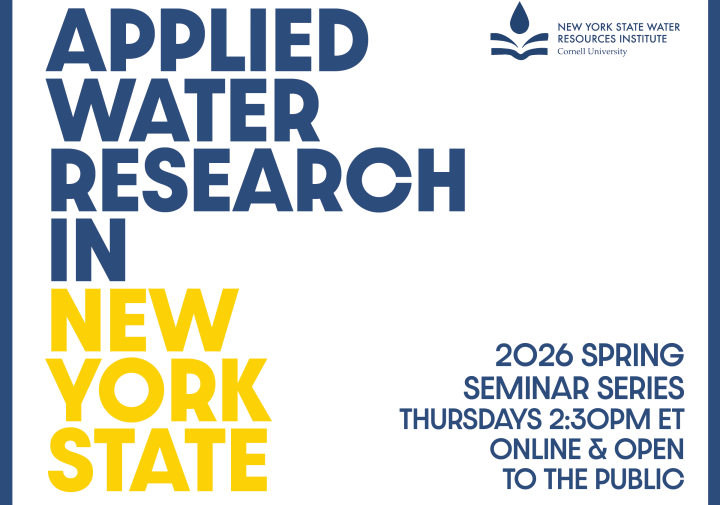
Every year, the New York State Water Resources Institute (NYSWRI) at Cornell supports applied research that address critical water resource problems in the New York State and the nation. This seminar series brings together researchers who work with NYSWRI and state agency partners to support and improve water management in the state. Speakers will present on a broad range of water related topics including water engineering and infrastructure, climate and flood resilience, water quality monitoring and assessment and aquatic ecosystems. The seminar will focus on ways in which robust science can support and influence on-ground management and policy outcomes, and center collaborative and interdisciplinary work between academics, water resource scientists, educators, managers, and policymakers in New York State.
Applied Water Research in New York State Spring 2026 Seminar Series will be held every Thursday at 2:30PM ET from January 22 - March 5, 2026.
Speakers: Alex Young (Cornell University PhD Candidate) w/introduction by Kristen Hychka (NYSWRI)
In urban areas, stormwater conveyance systems are the primary means for moving runoff away from populated areas to mitigate flooding. Over time, the conveyance and storage capacity can degrade due to aging components or debris buildup. These degradations - or faults - often go undetected in underground pipes or at the bottom of retention basins. Fortunately, measurements of depths, velocities, and flows from sensors distributed throughout the stormwater system can pick up the signatures of fault formation. Sensor-based fault monitoring is a relatively new approach to stormwater flood risk management, enabled by the decreasing costs of modular sensors. Two studies were done that address fault monitoring in stormwater systems which aim to close the gap on how distributed sensors can be used to detect and interpret fault signatures for flood risk management.
The first study maps flow sensor readings to parameter values in a numerical model to diagnose the most likely fault. The second study develops an algorithm for blockage detection from downstream depth measurements in an experimental laboratory test pipe. New fault detection methodologies help bridge the gap between sensing technology and flood risk management.
Date & Time
February 5, 2026
2:30 pm - 3:30 pm
More information about this event.
Contact Information
Ben Maracle
- bdm85 [at] cornell.edu
Speaker
Alex Young
Kristen Hychka
Departments
New York State Water Resources Institute
Related Events
Conference
Seminar

We openly share valuable knowledge.
Sign up for more insights, discoveries and solutions.